New: the federal battery rebate pays the full rate on the first 14 kWh, the exact size of the ElektroBank 14, and steps down over time.

LEVEL 2 EV CHARGER
Nearly every Level 2 charger lets you set a schedule, and the better ones add a surplus-solar mode or a time-of-use mode. That is where it stops.
They don’t move between sources as the cheapest one changes. In winter, when solar is half what it was, a solar-only mode simply stops working.
They don’t model your household usage and optimise on a second-by-second basis within the degrees of freedom you choose to give them.x`
They don’t respond when grid or market prices go negative and you are being paid to consume. That is the cheapest energy of the year, and it passes them by.
They don’t ley you set a minimum charge level, or guarantee a given amount of charge by a given time.
WHY THIS OnE
Controlling a charger properly needs three things at once: a fast and reliable communications link, granular power settings to align charging with excess solar, or to stay under a maximum demand tariff limit, and a low minimum. Most of the chargers we reviewed had a 2-3 kW minimum, lost their connection regularly, and some locked up entirely, requiring a manual reset. Ours does not – which is what makes both the optimisation and the experience work.

Step up to the fastest possible home charging with three-phase if your car supports it and your house is wired for it. Same price either way.

We developed a specific firmware build for this unit, running our Australian patented software, EmpowerIQ. It is not the charger you will find in a retail outlet.

Co-scheduled with every other device in the home against a 48-hour price forecast, using our Australian patented software.

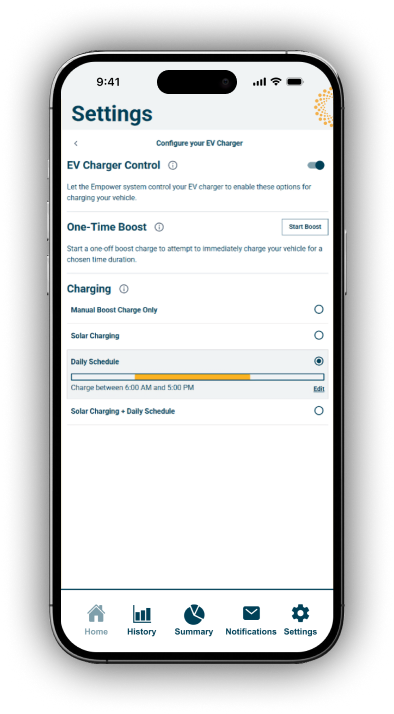
See the charger alongside your battery, solar and hot water. Set your preferences, or take manual control whenever you want it.

A full range of charging levels in fine increments, with a low minimum, so it can track your surplus as the kettle, the hot water and the battery all move.

Dropped communications are the most common failure in this category. This unit holds its link, and we monitor it.
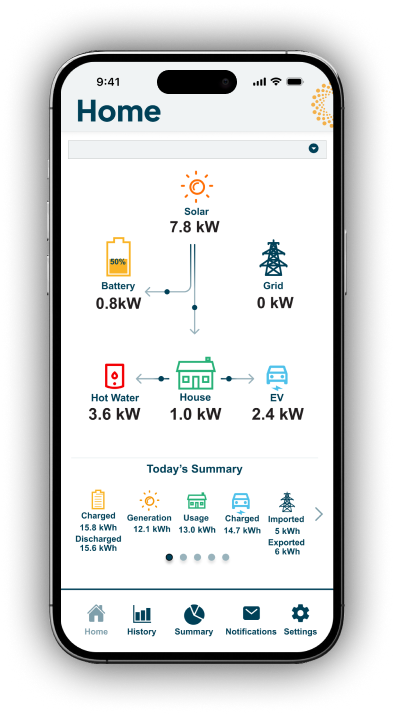
7.9 kW of solar going to the battery, the house and 2.4 kw into the car – with nothing coming off the grid.
Hand control to EmpowerIQ, boost on demand, or set solar charging, a daily schedule, or both together.
| Capability | Empower L2 charger | Typical L2 charger |
|---|---|---|
| Single-phase and three-phase | Both, same price | Three-phase costs much more |
| Charging power range | Fine increments, low minimum | 2–3 kW minimum, 1–2 steps or on / off only |
| Follows your lowest cost energy source as it changes | Yes | Solar mode or time-of-use mode |
| Switches sources mid-session automatically | Solar, grid or battery, second by second | No |
| Handles winter when solar is half | Blends the cheapest available source | Solar mode simply stops working |
| Negative price events | Maximises charging – you are paid to use | Not price-aware, so the opportunity passes |
| Set an amount by a given time | Ready-by targets | Minimum charge or scheduled charge only |
| Models your usage to optimise | Second by second, within your settings | No |
| Communications reliability | Hardened link, monitored | Frequent dropouts, some devices lock up |
| Firmware | Empower build, Australian patented software | Stock firmware, often developed for another country |
| In your home energy app | With battery, solar and hot water | Separate vendor app, if any |
| Optimised for wholesale electricity plans | Yes | No |
| Co-scheduled with battery and hot water | Yes | No |
| Keeps working if the internet drops | Yes | Cloud-dependent on most units |
Comparison is against Level 2 chargers commonly sold in Australia at a similar price point, based on our own review of dozens of units. Individual products vary – confirm against the specific unit you are comparing
Vehicle-to-grid could turn your car into the largest battery you own. The hardware is not there yet – most bidirectional units in Australia are still in trial, awaiting approval, or tied to a single vehicle. We will not offer one until it meets the same bar as everything else we sell.
Charged on grid power at the default market offer rate, a typical Sydney EV adds about $610 a year to your bill. Charged from whatever your least cost source happens to be at the time – given your preferences, your solar surplus and grid prices – it is closer to $140, assuming 12 kW of solar PV. Saving you around $470 a year, automatically.
Your own figure will differ, and for many households it will be materially larger: distance driven is the single biggest lever, and a household doing 20,000 km a year roughly doubles both numbers. Tariff, network area, solar size and battery capacity all move the answer too – use our savings calculator to get the number for your circumstances.
the ABS average annual distance for an Australian passenger vehicle
a Tesla Model S at its rated consumption, plus about 10% for AC charging losses. That is roughly 1,830 kWh of charging a year
the usage rate implied by the Ausgrid residential flat-rate default market offer for 2026-27 ($1,899 a year at 3,900 kWh, net of the daily supply charge)
An existing 12 kW rooftop solar system and an ElektroBank battery, with EmpowerlQ running the charger against its 48-hour load, PV generation and price forecast