New: the federal battery rebate pays the full rate on the first 14 kWh, the exact size of the ElektroBank 14, and steps down over time.
New: the federal battery rebate pays the full rate on the first 14 kWh, the exact size of the ElektroBank 14, and steps down over time.
Decarbonisation. Electrification. Two-way energy flows. Australia’s electricity system is being rebuilt from the ground up — and households that do nothing are facing bills up to 400% higher over the next 10 years. Solar alone won’t save you. Nor will a battery, an EV charger, or a heat pump on its own. The rules of running a home on electricity are about to change — and most homes are still in the dark.
+ Data centres
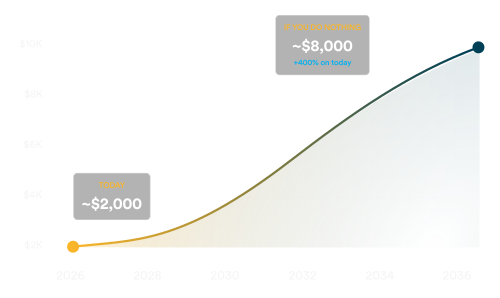
Australia is committed to net zero by 2045. That commitment is being written directly into your electricity bill — through transmission upgrades, distribution reinforcement, utility-scale batteries, new renewables, and the electrification of transport, heating, and cooking. Retail electricity bills are projected to rise two-to-four-fold over the coming decade for households that don’t adapt.
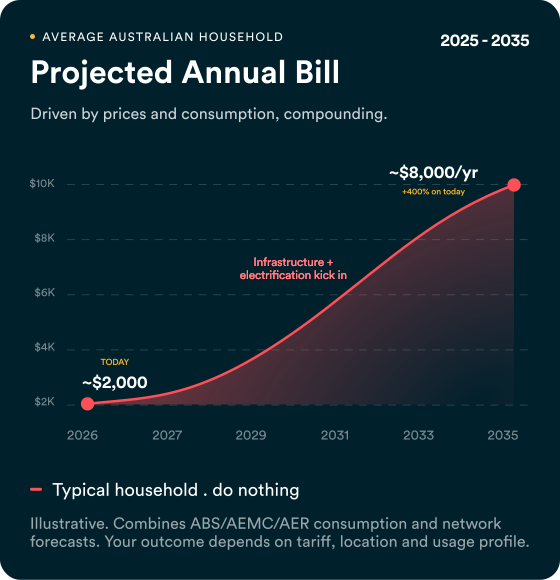
Renewables, utility batteries and transmission upgrades are funded through generation and transmission charges embedded in every retail bill. You pay them whether you use them or not.
Gas water heater, gas space heating and gas cooking bans — plus combustion-engine phase-outs — shift load you used to pay for at the pump or gas meter onto the electricity network.
One-way, peaky, largely fossil-generated. Retrofitting it for millions of EVs, rooftop solar and heat pumps is a national-scale infrastructure programme — and the cost flows through distribution charges.
AI-era compute is adding gigawatts of baseload that didn't exist five years ago — further tightening wholesale markets and raising prices for everyone.
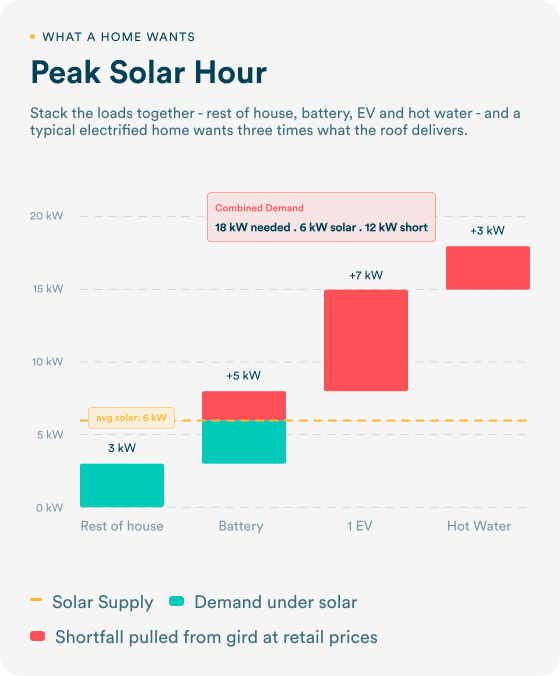
Adding clever devices one at a time feels like progress. It isn’t. Each device optimises for itself — and they end up fighting each other for solar export priority, charging at the wrong time, and leaving hundreds of dollars a month on the table.
Exports at 3–5¢/kWh and falling every year due to excess generation, costs you 30¢/kWh when you import. Will even cost you money when wholesale prices go negative during midday — which is happening more every year.
Exports cheap
Stores energy when there is excess or on a schedule. Can't respond to maximum demand tariffs, can't coordinate with EV charging or hot water, and adapts poorly on its own to real-time wholesale prices.
Dumb tank
Charges on excess solar or fixed schedule — and competes with the hot water and battery for the same kilowatts. No ability to dispatch against real-time, zero or negative prices or maximum demand tariffs..
Identical problem: pulls on solar first and tries to edges out the EV and battery. Great for brochures. Not great for bills.
Same fight
Four devices, four timers, four apps, four firmware schedules. None of them sees the wholesale price. None of them sees your maximum demand tariff. None of them sees tomorrow's weather. Each optimises for itself — not for you.
The Coming Shock
Not a generic customer average. Any system worth buying should learn your load shape and your roof — because no two homes behave the same.
Wholesale prices move 288 times a day. Rule-based timers set once a year can't keep up. Demand an optimiser that re-plans continuously against prices, state-of-charge and weather.
Not a generic customer average. Any system worth buying should learn your load shape and your roof — because no two homes behave the same.
Your hot water cylinder is a free 6–8 kWh thermal battery (~2,500 kWh/year ÷ 365 days). A system that can't control it leaves that capacity on the table — every single day.
Spot prices swing from −$1,000/MWh to $23,200/MWh. Any system that ignores them is ignoring the biggest savings lever of the next decade.
Free-electricity windows, time-of-use plans, solar sponge tariffs, controlled loads — and most critically, maximum demand charges, which most systems ignore and which are often the single biggest line on a modern bill.
Hybrid inverter + battery + energy-management controller in a single enclosure. Fewer boxes on your wall, less cabling, fewer warranty conversations, and a lower installed cost than stacking three separate vendors.
Spec sheets are easy. Ask for audited post-install savings data — real customers, real tariffs, real outcomes. If the vendor can't show you the numbers, you are the experiment.